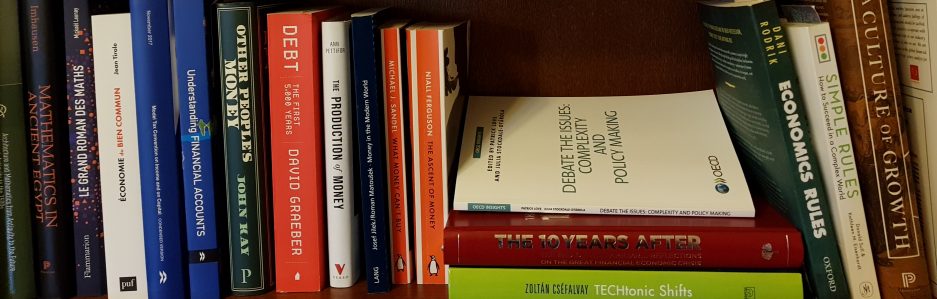
A useful textbook on broad money: Jilek and Matousek (2010)

Assume that you are teaching a ‘Monetary Economics’ course to an undergraduate class.  Your students would probably ask:

  • What do you mean by broad money?
  • What do you mean by a payment system?
  • How does the connection between cash and broad money work in practice?
  • How does broad money grow?
  • What kind of credit transactions enable money growth?
  • What are the other mechanics that affect money growth?
  • Can you give practical examples from the Eurozone, Japan, the United Kingdom and the United States?
  • Can you give hypothetical but simple illustrations on balance sheets and income statements?

If you have difficulty in motivating your students to read the ‘credit mechanics’ literature of the early to mid 20th century (see my previous blog entry on Decker and Goodhart, 2018), a practical way out would be to use the Jilek and Matousek (2010) as a supplementary text in class:

Jilek, Josef and Roman Matousek (2010) Money in the Modern World, Peter Lang, Frankfurt.

Although the book does not include much theory, I’m sure the students would enjoy,  and also benefit during their careers from, a basic knowledge of the mechanics of money.


A good starter before any theory of money: Decker and Goodhart (2018) remind us of the ‘credit mechanics.’

If the money multiplier is not a useful concept any more, how are we going to understand and model broad money growth?  In their recent paper, Frank Decker and Charles Goodhart tell us where to start:  ‘credit mechanics.’  The originators and contributors to this concept within the twentieth century are reminded in their paper:

Decker, F and C A Goodhart (2018), “Credit Mechanics – A Precursor to the Current Money Supply Debate”, CEPR Discussion Paper 13233.

My favourite part of their blog entry on this issue is:

Earlier it was based on the money multiplier, which implied that the money stock was driven primarily by changes to the central bank’s monetary base. This ignored the fact that, if the central bank wanted to fix a short-term interest rate – which it generally did – then the base had to adjust to commercial banks’ need for base money, rather than the reverse. Subsequently the divorce between the recent explosion in bank balances at the central bank and the sluggish growth in the broader money stock has scuppered the money multiplier approach. But this void is being filled by yet another partial equilibrium analysis, whereby the emphasis is focused entirely on the, supposedly unilateral, ability of the individual bank to create loans, and money, ex nihilo. In contrast, we argue that a more general approach to money supply theory involving credit mechanics and the influence of all those participating, bank debtors and creditors, both the non-bank private and the public sector, needs to be established.”

Decker, Frank and Charles A. Goodhart (2018), “Credit Mechanics – A Precursor to the Current Money Supply Debate”,  Blog entry on VOX CEPR Policy Portal, 14 Dec 2018,

https://voxeu.org/article/credit-mechanics-precursor-current-money-supply-debate

This suggested route may sound too complicated, especially for building a simple textbook model.  But unless we take it, there is no other chance of developing a really useful one.


“I had to throw out of the window everything I had learnt in textbooks …” says Borio (2019) on the concept of money multiplier.

The monetary base – such a common concept in the literature – plays no role in the determination of money supply (…)”

Borio, Claudio (2019) “On money, debt, trust and central banking,” BIS Working Papers No: 763, Bank for International Settlements, p.7, http://www.bis.org.

This recent paper of Claudio Borio, who currently is the Head of the Monetary and Economic Department of the BIS, is a must read for all students of monetary economics.

The way that monetary policy is conducted by central banks has changed fundamentally since early 1980s.  The central banks started to set the short term interest rate directly and use it as  their main policy instrument. Claudio Borio had recognized the potential implications of this structural change on monetary theory in mid 1990s:

This analysis is something any central banker responsible for implementation would find familiar. But it had not filtered through sufficiently to academia. When I first discovered it the mid 1990s, much to my disappointment I had to throw out of the window everything I had learnt in textbooks and at the university on the topic.”

Ibid, p.7.

Based on the experiences first of the Bank of Japan, and then after the global financial crisis,  of the Federal Reserve, of the Swiss National Bank and of the European Central Bank with either “large scale asset purchases” or “long term refinancing operations,” which increased free bank reserves held at the central bank and thereby the monetary base many times, with a negligible impact on the broad money stock, one cannot agree more with Borio (2019) in concluding:

(…) the money multiplier – the ratio of money to the money base – is not a useful concept.”

Ibid, p.7.

Yet I will argue in my future blog entries that explaining and modelling broad money growth via an alternative theory is possible, and would indeed be useful in macroeconomic policy analysis.