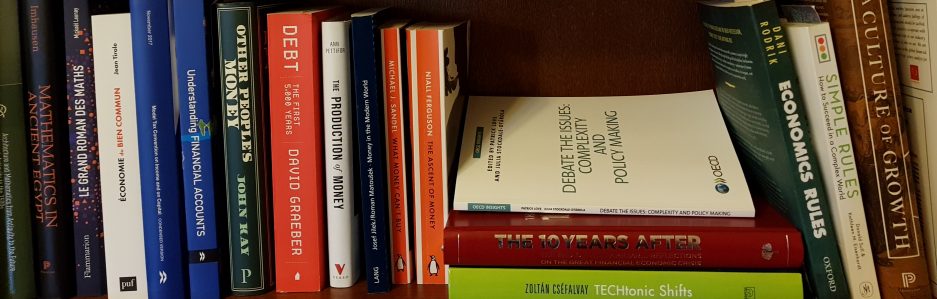
Money and productivity growth: Could Liu, Mian and Sufi (2019) be right?

There are three common observations from the last few decades:

  1. Total factor productivity has slowed down,
  2. Interest rates have come down,
  3. Broad money growth has slowed down.

For details of the former you may wish to see the recent OECD data.

For the later you may check my blog entry on ‘Broad money growth before and after 2009‘.

Now, the big question is whether these observations are related, and how.  An easy  approach would be to take the productivity slowdown as a given fact of life and based on that to prove that interest rates have to be lower in equilibrium.  This obviously leaves the productivity slowdown unexplained.

A recent NBER paper by Liu, Mian and Sufi (2019), takes a very different modelling approach based on an interesting narrative:

“Using firm-level data from the OECD, Berlingieri and Criscuolo (2017) and Andrews et al. (2016) show that the productivity gap between the 90th versus 10th percentile firms within industries has been increasing since 2000.

(…) the key point of departure is the insight that if the interest rate falls to a low enough level, then the rise in market concentration may itself constrain growth.”

from page 5 in,

LOW INTEREST RATES, MARKET POWER, AND PRODUCTIVITY GROWTH

Ernest Liu, Atif Mian, Amir Sufi

Working Paper 25505, http://www.nber.org/papers/w25505

NATIONAL BUREAU OF ECONOMIC RESEARCH,  January 2019

© 2019 by Ernest Liu, Atif Mian, and Amir Sufi


If there is truth in this striking and novel analysis, the fall in interest rates after the global financial crisis can theoretically be associated with the slowdown in the growth rate of productivity (and also of broad money).  But the causality this time runs from low demand and the associated low interest rates, to higher concentration, lower competition, lower innovation and thereby lower productivity growth.

These three empirical trends have been pronounced especially in Europe (after 2009) and in Japan (after 1995).  Reasons are still not so clear.

It is therefore very much worth thinking and working on this new approach and narrative further.



Broad money growth before and after 2009

Money growth in Europe before the global financial crisis (GFC) has been significantly above the reference rate initially set by the European Central Bank (ECB).

After the GFC, it is significantly below it.


                                                 M3 Growth
                        1999-2008     Reference     2009-2018

Eurozone                    7,7            4,5              2,9

UK                                 9,4             –               3,8

US                                  6,4             –               6,2

Sources: 
Organization for Economic Co-operation and Development, M3 for the Euro Area [MABMM301EZA657S], retrieved from FRED, Federal Reserve Bank of St. Louis; https://fred.stlouisfed.org/series/MABMM301EZA657S, April 6, 2019.
Organization for Economic Co-operation and Development, M3 for the United Kingdom [MABMM301GBA657S], retrieved from FRED, Federal Reserve Bank of St. Louis; https://fred.stlouisfed.org/series/MABMM301GBA657S, April 7, 2019.
Organization for Economic Co-operation and Development, M3 for the United States [MABMM301USA189S], retrieved from FRED, Federal Reserve Bank of St. Louis; https://fred.stlouisfed.org/series/MABMM301USA189S, April 6, 2019.
Averages over the two ten year periods are simple arithmetic averages and are author’s calculations. The OECD tells it  uses M2 as a proxy for M3 in US, since it is not published after 2006 any more.

A similar pattern is observed in UK.   Remarkably high money growth before the GFC and a noticeably low one after the GFC.

In the US, however, the average broad money growth both before and after the GFC were very similar at slightly above 6 percent.  This rate seems comfortable enough to accommodate a real GDP growth of around 3 percent, a price inflation of 2 percent and an additional increase in real money demand of 1 percent per annum.

Why did a similar outcome fail to realize in the Eurozone, where the ECB did have an initial emphasis on a monetary pillar around a reference broad money (M3) growth rate of 4,5 percent?

Why did the ECB stop mentioning the 4,5 percent reference rate after the Spring of 2003?

Why does broad money growth in the Eurozone fall short of 4,5 percent recently?

These are good questions to think about.


A useful textbook on broad money: Jilek and Matousek (2010)

Assume that you are teaching a ‘Monetary Economics’ course to an undergraduate class.  Your students would probably ask:

  • What do you mean by broad money?
  • What do you mean by a payment system?
  • How does the connection between cash and broad money work in practice?
  • How does broad money grow?
  • What kind of credit transactions enable money growth?
  • What are the other mechanics that affect money growth?
  • Can you give practical examples from the Eurozone, Japan, the United Kingdom and the United States?
  • Can you give hypothetical but simple illustrations on balance sheets and income statements?

If you have difficulty in motivating your students to read the ‘credit mechanics’ literature of the early to mid 20th century (see my previous blog entry on Decker and Goodhart, 2018), a practical way out would be to use the Jilek and Matousek (2010) as a supplementary text in class:

Jilek, Josef and Roman Matousek (2010) Money in the Modern World, Peter Lang, Frankfurt.

Although the book does not include much theory, I’m sure the students would enjoy,  and also benefit during their careers from, a basic knowledge of the mechanics of money.


A good starter before any theory of money: Decker and Goodhart (2018) remind us of the ‘credit mechanics.’

If the money multiplier is not a useful concept any more, how are we going to understand and model broad money growth?  In their recent paper, Frank Decker and Charles Goodhart tell us where to start:  ‘credit mechanics.’  The originators and contributors to this concept within the twentieth century are reminded in their paper:

Decker, F and C A Goodhart (2018), “Credit Mechanics – A Precursor to the Current Money Supply Debate”, CEPR Discussion Paper 13233.

My favourite part of their blog entry on this issue is:

Earlier it was based on the money multiplier, which implied that the money stock was driven primarily by changes to the central bank’s monetary base. This ignored the fact that, if the central bank wanted to fix a short-term interest rate – which it generally did – then the base had to adjust to commercial banks’ need for base money, rather than the reverse. Subsequently the divorce between the recent explosion in bank balances at the central bank and the sluggish growth in the broader money stock has scuppered the money multiplier approach. But this void is being filled by yet another partial equilibrium analysis, whereby the emphasis is focused entirely on the, supposedly unilateral, ability of the individual bank to create loans, and money, ex nihilo. In contrast, we argue that a more general approach to money supply theory involving credit mechanics and the influence of all those participating, bank debtors and creditors, both the non-bank private and the public sector, needs to be established.”

Decker, Frank and Charles A. Goodhart (2018), “Credit Mechanics – A Precursor to the Current Money Supply Debate”,  Blog entry on VOX CEPR Policy Portal, 14 Dec 2018,

https://voxeu.org/article/credit-mechanics-precursor-current-money-supply-debate

This suggested route may sound too complicated, especially for building a simple textbook model.  But unless we take it, there is no other chance of developing a really useful one.


“I had to throw out of the window everything I had learnt in textbooks …” says Borio (2019) on the concept of money multiplier.

The monetary base – such a common concept in the literature – plays no role in the determination of money supply (…)”

Borio, Claudio (2019) “On money, debt, trust and central banking,” BIS Working Papers No: 763, Bank for International Settlements, p.7, http://www.bis.org.

This recent paper of Claudio Borio, who currently is the Head of the Monetary and Economic Department of the BIS, is a must read for all students of monetary economics.

The way that monetary policy is conducted by central banks has changed fundamentally since early 1980s.  The central banks started to set the short term interest rate directly and use it as  their main policy instrument. Claudio Borio had recognized the potential implications of this structural change on monetary theory in mid 1990s:

This analysis is something any central banker responsible for implementation would find familiar. But it had not filtered through sufficiently to academia. When I first discovered it the mid 1990s, much to my disappointment I had to throw out of the window everything I had learnt in textbooks and at the university on the topic.”

Ibid, p.7.

Based on the experiences first of the Bank of Japan, and then after the global financial crisis,  of the Federal Reserve, of the Swiss National Bank and of the European Central Bank with either “large scale asset purchases” or “long term refinancing operations,” which increased free bank reserves held at the central bank and thereby the monetary base many times, with a negligible impact on the broad money stock, one cannot agree more with Borio (2019) in concluding:

(…) the money multiplier – the ratio of money to the money base – is not a useful concept.”

Ibid, p.7.

Yet I will argue in my future blog entries that explaining and modelling broad money growth via an alternative theory is possible, and would indeed be useful in macroeconomic policy analysis.


Sustainable finance for sustainable development (2018)

After the global financial crisis (GFC) of 2008, two concepts became very popular.  One is financial sustainability.  The other is sustainable development.

Sustainable development basically has three dimensions: economic, environmental and social.

There are very close links between financial sustainability and economic sustainability.   I summarized my thoughts on these in my recent paper “Sustainable finance for sustainable development.”  It is published last year (2018) in a book to commemorate the 10th anniversary of the GFC.   I include its reference and its manuscript version in this web site for your convenience.

I argue in Başçı (2018) why debt is individually very attractive and why speed limits to borrowing may be necessary and desirable for economic sustainability reasons.  These  limits can be summarized under the heading of prudential regulation.

Prudential regulation may also be useful for social and environmental sustainability.  I leave the social and environmental issues to other researchers (and perhaps to a few future posts in his blog).

Yet, because of the close connection between money and finance,  prudential regulation has very important implications on money supply as well.   I plan to write more about this later.


On Ferguson (2009) and Money

“(…) until we fully understand the origin of financial species, we shall never understand the fundamental truth about money (…)”

Niall Ferguson, The Ascent of Money: A Financial History of the World, (London, Penguin Books, 2009), p. 362.

Indeed, money and finance have been linked very closely to each other throughout history.   Ferguson (2009) gives a useful account this connection from a historical and  evolutionary perspective throughout his book.  He sees this connection natural and (perhaps) inevitable. Therefore, he uses the two concepts interchangeably in the book. The title of his final chapter is Afterword: The Descent of Money.  Yet, he feels the liberty of using ‘finance’ as a synonym for ‘money’.

“Still, I might equally well have paid homage to Charles Darwin by calling the book The Descent of Finance, for the story I told is authentically evolutionary.”

Ibid, p.362.

My arguments in this blog will be twofold.  First, an ‘engineered evolution’ has always been possible, and this is a good thing.  Second, finance is much more than money, and that this is a good thing, as well.

I am using the term engineered evolution in the sense used by experts of molecular biology and genetic engineering.   Although technological advances made biomedical genetic engineering possible only recently, financial history is full of interesting examples of economic genetic engineering.  Ferguson (2009) can be read via this lens, almost readily.  Of course some mutations have failed while some succeeded.  Yet most of them were deliberate innovations aimed to address the economic problems of their time.

Secondly, finance being broader than money, has been acknowledged by many economists, in fact early on.  It seems very likely now that technological advances of today will facilitate further both the development of finance and the development of money, in many cases distinctly from each other.  The gradual unbundling of the two will thereby be driven by technological change.  I see this unbundling as a deliberate and healthy process and will dwell on its benefits in my future remarks.


Fruits of money and finance

Money and finance have two separate functions. Fruits of both are needed. But they actually fulfill very different needs of the society.

Yet, the course of human history somehow bundled the two closely to each other. Quite closely indeed.

This tight bundling of money and finance to one another has given rise to significant economic policy challenges throughout history.

This observation is in fact a lens which makes reading research on money and finance much easier. The same lens also facilities fresh thinking on existing problems and their potential solutions.