Sustainable finance for sustainable development (2018)

After the global financial crisis (GFC) of 2008, two concepts became very popular.  One is financial sustainability.  The other is sustainable development.

Sustainable development basically has three dimensions: economic, environmental and social.

There are very close links between financial sustainability and economic sustainability.   I summarized my thoughts on these in my recent paper “Sustainable finance for sustainable development.”  It is published last year (2018) in a book to commemorate the 10th anniversary of the GFC.   I include its reference and its manuscript version in this web site for your convenience.

I argue in Başçı (2018) why debt is individually very attractive and why speed limits to borrowing may be necessary and desirable for economic sustainability reasons.  These  limits can be summarized under the heading of prudential regulation.

Prudential regulation may also be useful for social and environmental sustainability.  I leave the social and environmental issues to other researchers (and perhaps to a few future posts in his blog).

Yet, because of the close connection between money and finance,  prudential regulation has very important implications on money supply as well.   I plan to write more about this later.

 

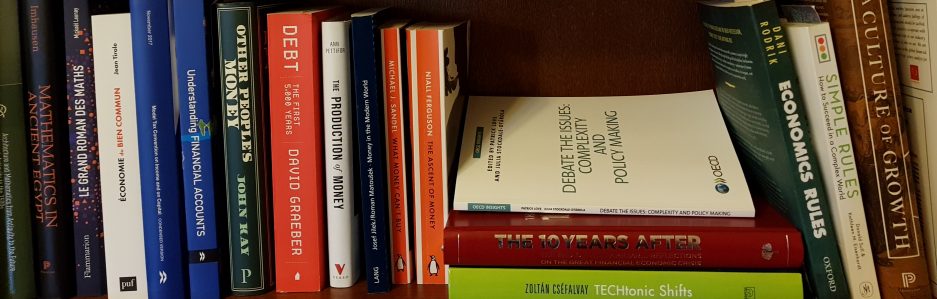
On Ferguson (2009) and Money

“(…) until we fully understand the origin of financial species, we shall never understand the fundamental truth about money (…)”

Niall Ferguson, The Ascent of Money: A Financial History of the World, (London, Penguin Books, 2009), p. 362.

Indeed, money and finance have been linked very closely to each other throughout history.   Ferguson (2009) gives a useful account this connection from a historical and  evolutionary perspective throughout his book.  He sees this connection natural and (perhaps) inevitable. Therefore, he uses the two concepts interchangeably in the book. The title of his final chapter is Afterword: The Descent of Money.  Yet, he feels the liberty of using ‘finance’ as a synonym for ‘money’.

“Still, I might equally well have paid homage to Charles Darwin by calling the book The Descent of Finance, for the story I told is authentically evolutionary.”

Ibid, p.362.

My arguments in this blog will be twofold.  First, an ‘engineered evolution’ has always been possible, and this is a good thing.  Second, finance is much more than money, and that this is a good thing, as well.

I am using the term engineered evolution in the sense used by experts of molecular biology and genetic engineering.   Although technological advances made biomedical genetic engineering possible only recently, financial history is full of interesting examples of economic genetic engineering.  Ferguson (2009) can be read via this lens, almost readily.  Of course some mutations have failed while some succeeded.  Yet most of them were deliberate innovations aimed to address the economic problems of their time.

Secondly, finance being broader than money, has been acknowledged by many economists, in fact early on.  It seems very likely now that technological advances of today will facilitate further both the development of finance and the development of money, in many cases distinctly from each other.  The gradual unbundling of the two will thereby be driven by technological change.  I see this unbundling as a deliberate and healthy process and will dwell on its benefits in my future remarks.


Fruits of money and finance

Money and finance have two separate functions. Fruits of both are needed. But they actually fulfill very different needs of the society.

Yet, the course of human history somehow bundled the two closely to each other. Quite closely indeed.

This tight bundling of money and finance to one another has given rise to significant economic policy challenges throughout history.

This observation is in fact a lens which makes reading research on money and finance much easier. The same lens also facilities fresh thinking on existing problems and their potential solutions.